0207 608 5500





Search ideas, news and case studies
Blog Categories
What Is the Companies House PROOF Service?


PROOF (PROtected Online Filing) is a free Companies House scheme that stops paper filings being accepted for your company, closing off one of the easiest routes for someone to make fraudulent changes to your record.
Key Takeaways
- PROOF is free to join and blocks paper forms, such as appointment changes, a registered office update, or a company name change, from being accepted for your company.
- Companies House applies an "in good faith" approach to paper filings, meaning signatures aren't thoroughly verified, which is exactly the gap PROOF closes.
- You'll need to be registered for WebFiling first, with your company number and authentication code to hand, before you can join.
- If you manage multiple companies, you need to register each one separately, PROOF doesn't cover your whole portfolio at once.
- Since October 2025, WebFiling itself requires signing in through GOV.UK One Login, an added step that sits alongside, not instead of, registering for PROOF.
Why Does PROOF Actually Matter?
That gap is exactly what makes company fraud possible in the first place. PROOF closes it by refusing paper filings for your company entirely, so any change has to go through your authenticated online account instead, where it's tied to your login and authentication code rather than a signature nobody's checking.
Companies House doesn't verify signatures on paper filings. A form changing your company's director, registered office, or name can be accepted without meaningful checks on who actually submitted it. PROOF is what closes that gap.
How Do I Register for PROOF?
Register for WebFiling first, if you haven't already. Our guide to registering for Companies House WebFiling covers the current process, including the GOV.UK One Login step introduced in October 2025.
Have your company number and WebFiling authentication code ready. If you manage more than one company, you'll need to repeat this process separately for each, since PROOF registration applies company by company, not across your whole portfolio at once.
Select "Join PROOF."
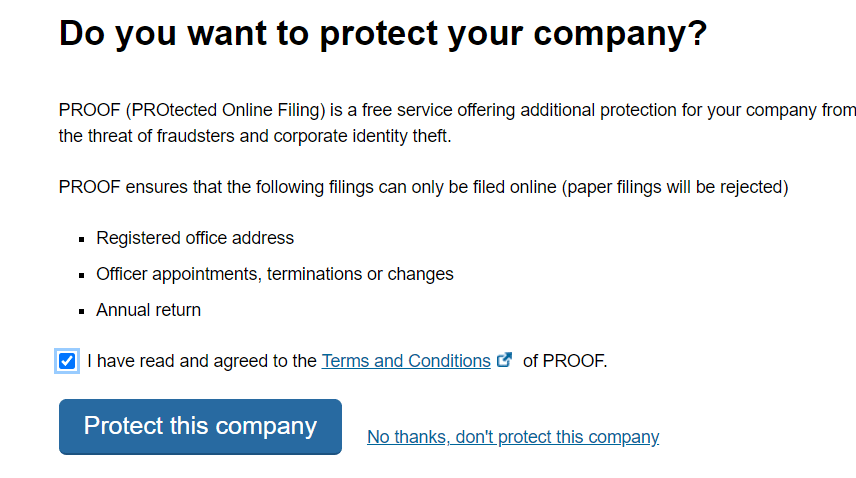
Once you have read through the terms, you can agree with them and select "Protect this company."
Does This Cover Everything I Need to Do to Protect My Company?
PROOF is a genuinely strong step, but it's one part of a broader picture. Using a private, non-home address for your registered office and director's service address, keeping your authentication code secure, and monitoring your company record for unexpected changes all matter too. Our guide to protecting your limited company from fraud covers the fuller picture.

You can also take a look at our own fraud protection service an option to help protect your company. This service will alert you instantly of any changes made through Companies House so you can act as soon as possible if this change was not authorised.
FAQs
What does PROOF actually protect against?
It stops paper filings being accepted for your company, closing off a common route for fraudulent changes like a fake director appointment or an unauthorised registered office update.
Does it cost anything to join PROOF?
No, it's a free Companies House scheme.
Do I need to register each company separately for PROOF?
Yes, if you manage more than one company, each needs its own separate PROOF registration.
Do I need anything else besides my authentication code to join PROOF?
Yes. You need to be registered for WebFiling, which since October 2025 requires signing in through GOV.UK One Login, in addition to your company number and authentication code.
Is PROOF enough on its own to protect my company from fraud?
It's a strong step, but not the whole picture. Address privacy, guarding your authentication code, and monitoring your company record for changes all matter too.
This article is for general information only and does not constitute legal advice. Companies House processes can change, so it's worth checking current guidance on GOV.UK or Companies House before relying on the details above.